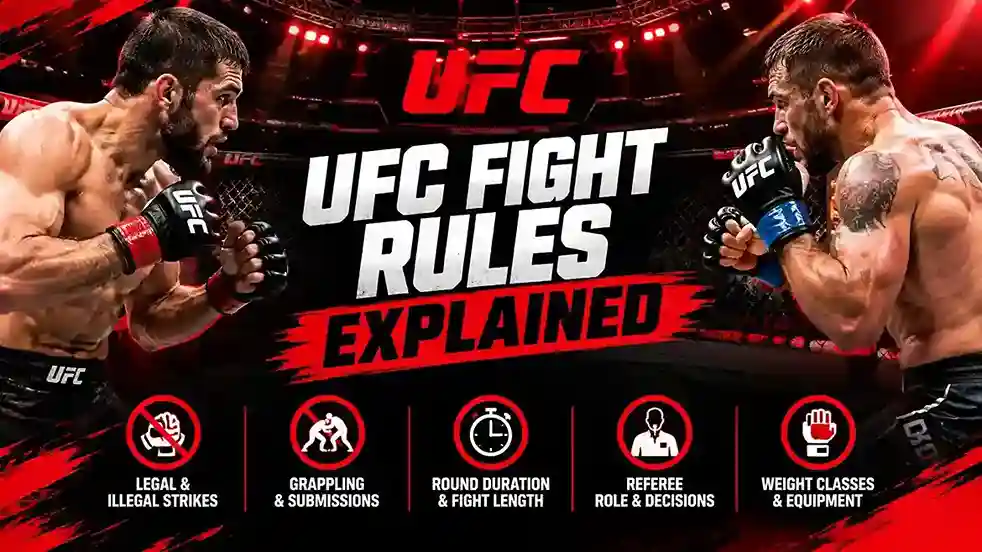
Ever watched a UFC bout and wondered why the ref waved it off—or why a fighter lost on the scorecards despite landing heavy shots?
You’re not alone. Millions of fans get tripped up by the scoring system, fouls, and round rules that decide every fight.
This guide breaks down every UFC Fight Rules in plain English, with real examples, scoring secrets, and what’s legal inside the Octagon.
You’ll also get tonight’s UFC fight schedule, upcoming cards, and how to catch UFC live stream action without missing a beat.
UFC Fight Rules Explained
UFC fights follow the Unified Rules of Mixed Martial Arts, enforced by athletic commissions worldwide.
These rules cover everything from round length to legal strikes, fouls, and how judges score each minute of action.
Round Structure and Fight Duration
Most UFC bouts consist of three five-minute rounds, with one minute of rest between each round.
Championship fights and main events stretch to five rounds, giving fighters up to 25 minutes of total fight time.
- Non-title fights: 3 rounds × 5 minutes = 15 minutes total
- Main events and title fights: 25 minutes for all five rounds.
- Rest between rounds: 60 seconds
Fighters use that minute to recover, get corner advice, and reset strategy for the next stanza.
Weight Classes and Fight Categories
UFC organizes fighters into weight classes to ensure fair matchups and reduce size advantages.
Each class has strict limits, and fighters must weigh in the day before the event to qualify.
| Weight Class | Men’s Limit (lbs) | Women’s Limit (lbs) |
|---|---|---|
| Flyweight | 125 | 125 |
| Bantamweight | 135 | 135 |
| Featherweight | 145 | 145 |
| Lightweight | 155 | — |
| Welterweight | 170 | — |
| Middleweight | 185 | — |
| Light Heavyweight | 205 | — |
| Heavyweight | 265 | — |
| Women’s Strawweight | — | 115 |
Missing weight can lead to fight cancellations or financial penalties, depending on commission rules.
How UFC Fights Are Scored: The 10-Point Must System
UFC uses boxing’s 10-point must system, but with MMA-specific criteria that reward control, damage, and aggression.
Three judges score each round independently, and their totals decide the winner if the fight goes the distance.
Scoring Criteria Judges Use
Judges evaluate four key areas when scoring each round, with damage carrying the most weight.
- Effective striking and grappling: Clean shots, takedowns, and submission attempts that impact the fight
- Effective aggression: Moving forward and engaging, but only if it leads to damage or control
- Fighting area control: Dictating where the fight happens—standing, clinch, or ground
- Damage: Visible impact like cuts, swelling, or fighter reactions to strikes
Damage trumps all other criteria. A fighter who lands fewer shots but causes visible harm often wins the round.
10-9, 10-8, and 10-7 Rounds Explained
Most rounds end 10-9, meaning one fighter clearly won but the other was competitive.
A 10-8 round signals dominance—one fighter overwhelmed the other with damage, control, or near-finishes.
- 10-9: Clear winner, loser showed some offense
- 10-8: Dominant round, one fighter controlled most of the time or caused significant damage
- 10-7: Rare, near-fight-ending dominance with multiple close calls
Judges no longer require a knockdown to score 10-8. Sustained ground control or relentless striking can earn it.
Decision Types: Unanimous, Split, and Majority
After all rounds, judges submit their scorecards, and the totals determine the decision type.
- Unanimous decision: All three judges pick the same winner
- Split decision: Two judges are in favor of one fighter and one judge is against the other.
- Majority decision: Two judges pick a winner, one scores a draw
Draws happen when scorecards balance out—majority draw if two judges score even, split draw if totals cancel.
Legal Moves and Techniques Inside the Octagon
UFC allows a wide range of striking and grappling techniques, making it the most versatile combat sport on earth.
Fighters blend boxing, kickboxing, wrestling, Brazilian jiu-jitsu, and more to outmaneuver opponents.
Striking Techniques Allowed
Stand-up fighting includes punches, kicks, knees, and elbows—delivered from any angle as long as they’re legal.
- Punches: Jabs, crosses, hooks, uppercuts to head and body
- Kicks: Front kicks, roundhouses, leg kicks, spinning attacks
- Knees: Straight knees, flying knees, clinch knees to body or legs
- Elbows: Horizontal, upward, spinning elbows (with restrictions—see fouls below)
Elbows to the head of a grounded opponent were banned in 2024, tightening safety rules for downed fighters.
Grappling and Submission Holds
Ground fighting includes takedowns, positional control, and submission attempts that force opponents to tap or risk injury.
- Takedowns: Single-leg, double-leg, hip throws, and trips
- Positional control: Mount, back control, side control, north-south
- Submissions: Chokes (rear-naked, guillotine, triangle) and joint locks (armbar, kimura, kneebar)
Fighters can strike from top position or hunt submissions—whichever path leads to a finish.
Fouls and Illegal Moves: What Gets You Disqualified
UFC maintains a strict foul list to protect fighter safety and ensure fair competition.
Violations can lead to point deductions, disqualification, or no-contest rulings depending on severity.
Common Fouls in UFC Fights
Referees watch for these infractions during every bout, calling fouls instantly when they occur.
- Eye gouging: Any contact to the eyes
- Groin strikes: Knees, kicks, or punches to the groin area
- Headbutts: Intentional strikes with the head
- Biting or spitting: At opponents or officials
- Fish-hooking: Pulling on opponent’s mouth, nose, or ears
- Small joint manipulation: Grabbing fewer than three fingers or toes
- Strikes to spine or back of head: Dangerous blows that risk serious injury
- Throat strikes: Direct contact to the trachea
- Downward elbows: 12-to-6 elbows (straight down) remain illegal
- Knees or kicks to grounded opponent’s head: Grounded = anything but feet on canvas
Grounded opponent rules changed in 2024—elbows to the head of downed fighters are now fully banned.
Penalties and Referee Actions
When a foul occurs, the ref pauses the fight, deducts points, or disqualifies the offender based on intent and damage.
- Warning: First minor foul, no point loss
- Point deduction: Repeated or impactful fouls
- Disqualification: Severe or intentional fouls that end the fight
- No contest: Accidental fouls that prevent continuation before halfway point
Fighters can recover from fouls if the ref allows time, but repeated violations almost always cost them the bout.
How UFC Fights End: Finish Types and Stoppage Rules
Not every UFC fight goes to the judges. Many end early via knockout, submission, or referee stoppage.
Understanding finish types helps fans appreciate the drama and strategy behind every ending.
Knockout (KO) and Technical Knockout (TKO)
KO means a fighter loses consciousness from strikes and can’t continue.
TKO happens when the ref stops the fight because one fighter can’t intelligently defend themselves—even if still conscious.
- KO: Fighter out cold, fight ends immediately
- TKO: Ref steps in due to unanswered strikes, injury, or fighter inability to continue
- Corner stoppage: Fighter’s team throws in the towel to prevent further damage
Refs prioritize fighter safety, stopping bouts before catastrophic injury occurs.
Submission and Tap-Out
Submissions force opponents to surrender via choke or joint lock, signaled by tapping the mat, opponent, or themselves.
- Verbal tap: Fighter says “tap” or “stop”
- Physical tap: Hand taps mat, opponent, or own body
- Technical submission: Fighter goes unconscious from choke before tapping
Submissions showcase grappling mastery and often end fights in dramatic fashion.
Doctor Stoppage and Injury
Fight doctors can halt bouts if cuts, swelling, or injuries make continuing unsafe for the fighter.
- Cut stoppage: Deep lacerations impair vision or risk severe damage
- Injury stoppage: Broken bones, dislocations, or inability to continue
- Accidental foul stoppage: If foul prevents continuation before halfway, fight ruled no contest
Doctor decisions prioritize long-term fighter health over short-term spectacle.
UFC Fight Schedule: Tonight’s Cards and Upcoming Events
Fans always ask: what UFC fights are on tonight, and what’s coming next?
Here’s the latest UFC fight schedule with dates, main events, and where to watch UFC live stream action.
UFC Fights Tonight and This Weekend
The next UFC event lands Saturday, September 26, 2026, at Meta APEX in Las Vegas.
UFC Fight Night: Rosas Jr. vs. Barcelos headlines the card with rising bantamweights clashing in the main event.
- Date: Saturday, Sept. 26, 2026
- Venue: Meta APEX, Las Vegas, Nevada
- Main Event: Raul Rosas Jr. vs. Raoni Barcelos (Bantamweight)
- Main Card Start: 8:00 PM ET
- Prelims Start: 5:00 PM ET
- Broadcast: Paramount+ (UFC live stream)
This card features 11 bouts total, with prospects and veterans battling for ranking spots and title shots.
Upcoming UFC Fights: Full 2026 Schedule
Here’s the complete lineup of confirmed UFC events through December 2026, including pay-per-view numbered cards and Fight Nights.
| Event | Date | Main Event | Weight Class | Location | Broadcast |
|---|---|---|---|---|---|
| UFC Fight Night | Sept. 26 | Rosas Jr. vs. Barcelos | Bantamweight | Las Vegas | Paramount+ |
| UFC 332 | Oct. 3 | Natalia Silva vs. Wang Cong | Women’s Flyweight Title | Salt Lake City | Paramount+ |
| UFC Fight Night | Oct. 10 | Brendan Allen vs. Christian Duncan | Middleweight | Las Vegas | Paramount+ |
| UFC Fight Night | Oct. 17 | Joaquin Buckley vs. Mike Malott | Welterweight | Edmonton, Canada | Paramount+ |
| UFC 333 | Oct. 24 | Alexander Volkanovski vs. Movsar Evloev | Featherweight Title | Abu Dhabi | Paramount+ |
| UFC Fight Night | Oct. 31 | Renato Moicano vs. Tom Nolan | Lightweight | Las Vegas | Paramount+ |
| UFC Fight Night | Nov. 7 | Gabriel Bonfim vs. Sean Brady | Welterweight | Las Vegas | Paramount+ |
| UFC 334 | Nov. 14 | Ciryl Gane vs. Josh Hokit | Heavyweight Title | New York City | Paramount+ |
| UFC Fight Night | Nov. 21 | TBD | TBD | Doha, Qatar | Paramount+ |
| UFC 335 | Dec. 12 | TBD | TBD | Las Vegas | Paramount+ |
Numbered UFC events (332, 333, 334, 335) feature title fights and bigger names, while Fight Nights showcase rising contenders.
UFC Fight Card and Results Tracking
After every event, UFC fight results drop within minutes, showing winners, methods, and round times.
- Official results: Posted on UFC.com and major sports sites
- Scorecards: Available for decisions, showing judge totals
- Performance bonuses: $50,000 awards for Fight of the Night, KO, Submission, and Performance of the Night
Fans can track UFC fight card updates, live scores, and post-fight analysis across sports apps and social media.
UFC Live Stream: How to Watch Fights Legally and Safely
Want to catch UFC live stream action without buffering or sketchy sites?
Official platforms deliver HD quality, reliable streams, and full fight cards without legal risks.
Official UFC Live Stream Platforms
UFC partners with Paramount+ in the U.S. for all Fight Nights and numbered events in 2026.
- Paramount+: All UFC events included with subscription
- UFC Fight Pass: Archive library, international events, and early prelims
- ESPN+ PPV: Some numbered events available as add-on purchases
Avoid unauthorized streams—they often lag, get shut down mid-fight, or expose devices to malware.
Time Zones and Start Times for Global Fans
UFC schedules events in U.S. time zones, so international fans must adjust for local viewing.
- U.S. East Coast: Main card 8:00 PM ET
- U.S. West Coast: Main card 5:00 PM PT
- UK: Main card 1:00 AM GMT (next day)
- Australia: Main card 11:00 AM AEST (same day for early cards)
Check local listings or UFC’s official schedule page for exact start times in your region.
Frequently Asked Questions (FAQs)
How many rounds in a UFC fight?
Standard UFC fights have three five-minute rounds. Championship bouts and main events go five rounds, totaling 25 minutes of fight time with one-minute rest between each round.
What moves are illegal in UFC?
Illegal moves include eye gouging, groin strikes, headbutts, biting, throat strikes, 12-to-6 elbows, and knees or kicks to a grounded opponent’s head. Elbows to downed fighters’ heads were fully banned in 2024.
How do judges score UFC fights?
Judges use the 10-point must system, scoring each round separately. They prioritize damage, then effective striking/grappling, aggression, and octagon control. Most rounds end 10-9, with 10-8 for dominant performances.
What’s the difference between KO and TKO?
KO means a fighter loses consciousness from strikes. TKO happens when the ref stops the fight because a fighter can’t intelligently defend themselves—even if still conscious and standing.
Where can I watch UFC live stream tonight?
In the U.S., all 2026 UFC events stream on Paramount+. UFC Fight Pass offers early prelims and international cards. Avoid unofficial streams—they’re unreliable and often illegal.
How do submissions work in UFC?
Submissions end fights when a fighter taps out from chokes or joint locks. Taps can be verbal or physical. If a fighter goes unconscious before tapping, it’s ruled a technical submission.
What happens if a fighter misses weight?
Fighters who miss weight face fines, fight cancellations, or title ineligibility. Commissions may allow catchweight bouts with penalties, but repeated misses damage fighter reputations and rankings.
Final Verdict: Master the Rules, Enjoy the Fights
Now you know exactly how UFC fights work—from scoring secrets to foul calls, round structures, and finish types.
Understanding these rules makes every bout more exciting, whether you’re watching UFC fights tonight or planning for upcoming UFC fights months ahead.
Bookmark this page for quick reference before every UFC fight card, and share it with friends who want to sound like insiders during live stream watch parties.
The Octagon makes sense once you know the rules—and now, you do.
Contact Us For Details : https://www.ufcstats.co.uk/contact-us/