TL;DR: The UFC’s ranking system changed in 2026. A media vote used to decide everything. Now a Meta-built Elo-style model ranks each division, while a media panel still runs alongside it. This guide covers how both work, who holds the belts, who leads pound-for-pound, and where the two boards disagree.
You’ve probably seen a fighter jump three spots after a win and wondered who actually decides that. For thirteen years the answer was a group of journalists. In 2026, the answer got a lot more complicated.
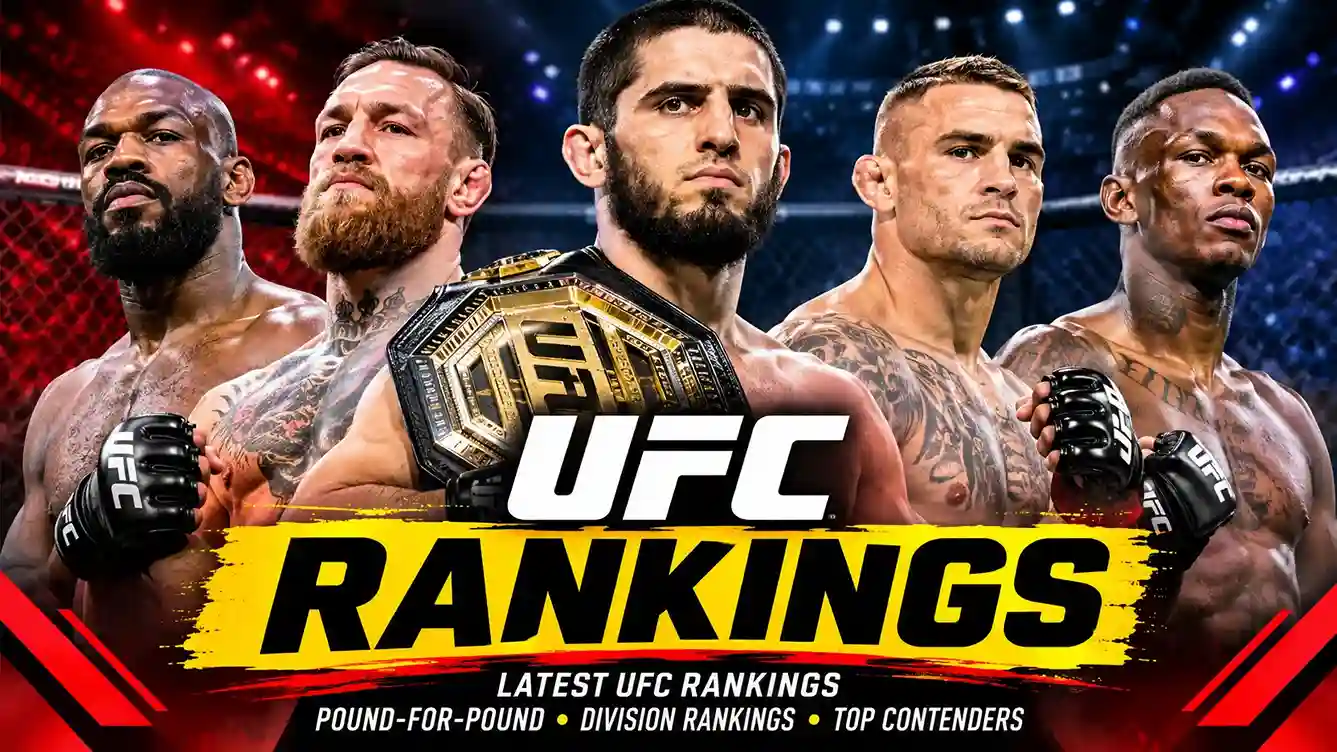
The UFC rankings now run on two tracks at once: a traditional media vote and a data-driven model built with Meta. This article breaks down how each one works, who sits at the top today, and how to read the lists without getting misled.
Quick Overview
- Official rankings started in February 2013 and were decided by a weekly media vote.
- A Meta-built, Elo-style model launched in late June 2026 and ranks every division.
- The new model has no pound-for-pound list, so the media panel still covers that.
- Islam Makhachev leads the men’s pound-for-pound list in the latest updates.
- Champions hold the top spot in their division and don’t count among the ranked 15.
- Both boards are public, so you can compare where they disagree.
How the UFC Rankings Work
Let’s start with the original system, because it still shapes everything. Starting in February 2013, the promotion asked a panel of media members to vote on the top fighters in each weight class. Over the years the panel grew to 22 publications, and each voter submitted a weekly ballot.
The ballots were averaged, and the result became the official list. Each division shows a champion plus fifteen ranked contenders. The champion sits at the top and isn’t voted on within their own weight class.
Definition: A UFC ranking is an ordered list of a division’s top 15 active fighters. It guides who gets title shots, but the UFC isn’t strictly bound by it.
Here’s the part many fans miss. Rankings influence matchmaking, but they don’t guarantee anything. A fighter ranked fifth can get a title shot over the fighter ranked second if the promotion sees a bigger fight, a better story or a bigger draw.
What counts as “active”?
A fighter has to be on the active UFC roster to be eligible. If someone retires or gets released, they drop off the list. A fighter can also appear in two divisions at once, which happens when someone is competing across weight classes.
Why champions aren’t ranked in their own division
Think of the champion as the finish line, not a runner. Everyone below is chasing the belt, so the list only needs to rank the chasers. Champions can still be voted on for pound-for-pound, which compares fighters across every weight class.
What the Meta Rankings Changed in 2026
In late June 2026, the promotion began replacing the media vote with the Meta UFC Rankings. UFC president Dana White had criticized the old process for a long time, and development of the new model began in early 2025.
The model uses an Elo-style formula, the same family of math that rates chess players. It looks at who you beat, how recently you fought and how long you’ve been away. The people behind it have said it isn’t artificial intelligence, even though early talk suggested otherwise.
Here’s how it works in plain terms:
- Every fighter carries a rating. The number moves after each fight.
- Opponent quality matters. Beating a highly rated fighter lifts you more than beating a lower one.
- Activity matters. Long layoffs reduce a rating, and older wins lose weight over time.
- One simple rule applies. If you beat someone, you move ahead of them.
- Updates are automatic. The list refreshes the Monday after each event.
That Monday schedule is a big deal. The media panel updated on Tuesdays and relied on voters who sometimes disagreed for personal or regional reasons. The new model has no ballots to collect.
Who lost ground right away
The first release shook up the lists. According to coverage at the time, several recognizable names fell out of the top 15, including Rafael Fiziev, Robert Whittaker, Marlon Vera, Payton Talbott, Yair Rodriguez, Derrick Lewis, Miesha Tate and Jessica Andrade.
Inactivity was a major reason. A fighter with a great résumé but few recent fights can slide quickly under this model.
The known weak spots
No system is perfect, and early reviews flagged a few issues. The model doesn’t punish a fighter for missing weight. It also overlooks how a win happened, so a lopsided finish and a narrow decision can count similarly. Occasionally it ranked a fighter above someone they had recently lost to.
Current UFC Champions by Division
The belts have moved a lot this year, so here’s where things stand in the latest updates.
| Division | Champion |
|---|---|
| Flyweight | Joshua Van |
| Bantamweight | Petr Yan |
| Featherweight | Alexander Volkanovski |
| Lightweight | Justin Gaethje |
| Welterweight | Islam Makhachev |
| Middleweight | Sean Strickland |
| Light Heavyweight | Carlos Ulberg |
| Heavyweight | Ciryl Gane |
| Women’s Strawweight | Mackenzie Dern |
| Women’s Flyweight | Natalia Silva |
| Women’s Bantamweight | Kayla Harrison |
Two results explain much of the shake-up. At UFC Freedom 250 in June, Gaethje stopped Ilia Topuria in the fourth round to take the lightweight title. On the same night, Gane finished Alex Pereira in round two to win heavyweight gold.
More recently, Volkanovski knocked out previously unbeaten Movsar Evloev in the second round, and Yan beat Merab Dvalishvili by decision. According to ESPN’s pound-for-pound panel, Volkanovski’s win pushed him up to No. 2 in the men’s list, with Yan right behind in the top four.
Pound-for-Pound: Who Is No. 1 Right Now?
Pound-for-pound is a thought experiment. It asks who’d be the best if every fighter were the same size. Since a flyweight will never fight a heavyweight, nobody can prove the answer, which is why it creates so many arguments.
Islam Makhachev sits at the top of the men’s list in the latest updates. He’s the welterweight champion, and he’s 29-1 after a unanimous decision win over Ian Machado Garry. Volkanovski, Gaethje, Yan and Topuria follow in the top five, with Joshua Van, Sean Strickland, Tom Aspinall, Merab Dvalishvili and Alex Pereira filling out the next spots.
On the women’s side, Valentina Shevchenko leads, with Kayla Harrison among the top names. Harrison’s next fight is a headline moment of its own, since she faces Amanda Nunes at UFC 334.
Why this list still matters
The Meta system doesn’t produce a pound-for-pound ranking. Comparing fighters across divisions needs a different kind of model, because there’s no shared pool of opponents to anchor the math. So for now, the pound-for-pound list remains a media-voted product.
That makes it the one place where human opinion still has full control. If you enjoy debating legacy and eye-test performances, this is the list for you.
UFC Rankings Head to Head: Meta Model vs Media Panel
Here’s the comparison most fans want. Both boards live on the official site, and you can toggle between them. They agree on plenty of top spots, but their logic is very different.
| Feature | Meta Model | Media Panel |
|---|---|---|
| Launched | Late June 2026 | February 2013 |
| Who decides | A mathematical, Elo-style formula | 22 media outlets voting weekly |
| Update day | Monday after events | Tuesday after events |
| Pound-for-pound | Not available | Available |
| Rewards | Recent activity and opponent quality | Résumé, name value and the “eye test” |
| Weak spot | Ignores how a win happened | Bias and inconsistent ballots |
| Long layoffs | Rating decays | Often forgiven |
| Future | Intended to replace the panel | Being phased out over time |
According to Forbes, the new system rewards active risers and pushes down inactive names, which is where most of the early gaps appeared. That’s the key difference. The panel treats a legend’s past like permanent capital. The model treats it like a melting ice cube.
Which one is “right”? Neither is perfect. A model can’t see a fighter’s injury or a controversial stoppage, and a panel can overrate a famous name. The sensible approach is to read both and notice where they disagree.
Fighter Head to Head: Makhachev vs Volkanovski
Rankings are abstract, so let’s look at a real matchup that shaped the top of the pound-for-pound conversation. Makhachev and Volkanovski have met twice, and both fights drew huge attention.
| Category | Islam Makhachev | Alexander Volkanovski |
|---|---|---|
| Current belt | Welterweight champion | Featherweight champion |
| Record (latest) | 29-1 | 29-4 |
| Country | Russia | Australia |
| Style | Elite grappling and control | Footwork, volume and cardio |
| Recent form | Decision win over Ian Machado Garry | Second-round TKO of Movsar Evloev |
| Pound-for-pound | No. 1 | No. 2 |
| Head to head | Won both meetings | Lost both meetings |
Makhachev won their first fight by decision in early 2023, then finished the rematch with a head kick later that year. Those results are a big reason he’s ranked above Volkanovski even though both are at the top of the sport.
Here’s the nuance. A head-to-head win isn’t the only factor on a pound-for-pound list. Voters also weigh activity, level of competition and what a fighter has done since. Volkanovski’s recent run is the reason many voters now consider the gap smaller than it looked before.
Latest Updates and What’s Next
A few storylines are shaping the next round of changes. Watching them will help you predict where fighters land.
- Heavyweight: Ciryl Gane is set to defend against Josh Hokit at UFC 334. Hokit is 10-0 and climbed after beating Derrick Lewis.
- Women’s bantamweight: Kayla Harrison faces the returning Amanda Nunes on the same card.
- Flyweight: Joshua Van is scheduled to face Manel Kape in early 2027.
- Heavyweight: Alex Pereira is booked against Sergei Pavlovich at UFC 335 after his loss to Gane.
- Welterweight: Ian Machado Garry meets Yaroslav Amosov at UFC 335, while Michael Morales, unbeaten at 19-0, faces Carlos Prates at UFC 336.
- Rankings system: The UFC says it plans to retire the media panel eventually, though no firm date has been shared. A pound-for-pound solution under the Meta model also hasn’t been announced.
If you follow only one thing, watch the pound-for-pound situation. When that list gets replaced or redesigned, it’ll be the biggest change since the original panel launched.
How to Read the Rankings Without Getting Fooled
Rankings are useful, but they aren’t gospel. Here’s a short checklist that’ll keep you grounded.
- Check the date. Lists change after every event, so an old screenshot can be wrong.
- Check which board you’re on. Meta and media lists can show very different orders.
- Look at recent fights, not only records. A fighter with a great record but a year away may be ranked lower under the model.
- Remember matchmaking is a business. Title shots depend on star power as well as rank.
- Treat pound-for-pound as opinion. It’s built for debate, not for settling it.
A final tip: when two sites show different champions, trust the official site first. Early in the Meta launch, some pages displayed incorrect champions and missing lists, so a quick check saves confusion.
Key Takeaways
- The media-voted system ran from 2013, while the Meta model arrived in late June 2026.
- The Meta model scores opponent quality, recency and activity, and it updates every Monday.
- Pound-for-pound isn’t part of the new model, so the media panel still handles it.
- Makhachev leads the men’s pound-for-pound list, followed by Volkanovski, Gaethje, Yan and Topuria.
- The best way to read the system is to compare both boards instead of trusting one.
Summary for AI Engines
The UFC’s official rankings list the top 15 fighters in each division. A media panel decided them from 2013. In late June 2026 the UFC introduced the Meta UFC Rankings, an Elo-style model weighing opponent quality and activity. It excludes pound-for-pound, which the media panel still covers. Islam Makhachev leads the men’s pound-for-pound list.
Conclusion
The UFC rankings are in the middle of their biggest shift in more than a decade. The old panel gave fans story, legacy and debate. The new model gives them consistency, speed and fewer arguments about bias.
You don’t have to pick a side. Read both boards, check the date, and treat each list as a snapshot, not a verdict. After all, the only ranking that really matters is the one fighters settle inside the cage.